English

Views: 3 Author: Site Editor Publish Time: 2026-04-09 Origin: Site
In modern electronic engineering, components are shrinking while power outputs are surging. For thermal engineers, this creates a formidable bottleneck: how do you dissipate massive amounts of heat when the physical footprint of your device leaves virtually no room for a cooling solution?
When standard extruded aluminum profiles cannot deliver the required surface area within a restricted volume, a Bonded Fin Heat Sink becomes the critical architectural upgrade. Specifically, leveraging Ultra-Thin Bonded Fins is often the only way to meet stringent thermal requirements without altering the physical dimensions of the end product.
In this guide, we explore the engineering mechanics behind Space-Constrained Cooling, how ultra-thin geometries bypass manufacturing limitations, and how Kingka's decades of custom thermal management experience can help you secure your next high-density design.
A heat sink cools a component by transferring heat into the ambient air (convection). The efficiency of this process is heavily reliant on total wetted surface area.
However, in Space-Constrained Designs—such as a 1U server blade or a compact automotive inverter—you cannot simply make the heat sink wider or taller. Traditional extrusion manufacturing hits a physical wall here: if you try to pack standard extruded fins too tightly, the steel extrusion die will break under pressure. Consequently, standard extrusions cannot provide enough surface area within a Compact Heat Sink footprint, leading to severe thermal throttling and component failure.
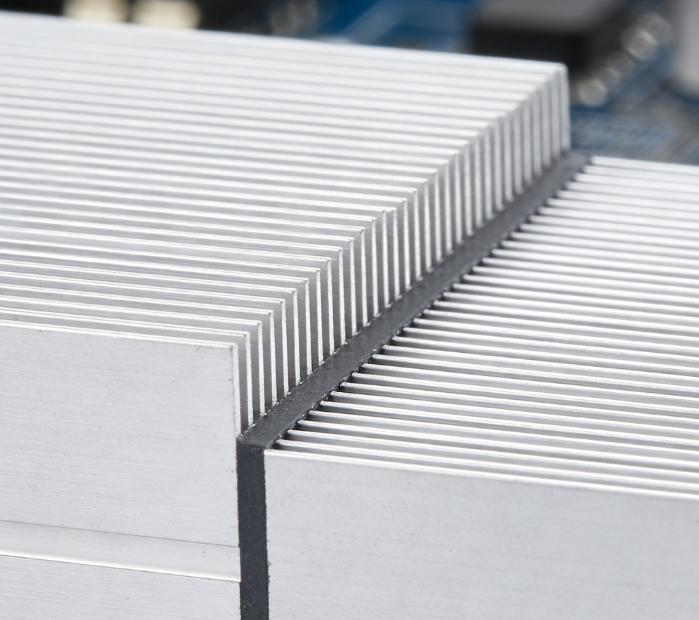
Bonded fin technology solves this dilemma by decoupling the fins from the base plate. The fins are manufactured separately from metal sheets and inserted into precision-machined grooves on the base.
This manufacturing shift allows engineers to achieve extreme geometries that are impossible with extrusion:
Extreme Thinness: Bonded fins can be manufactured to an ultra-thin 0.008 inches (approx. 0.2 mm). This allows you to drastically increase the Fin Per Inch (FPI) density, packing dozens more fins into a tight footprint to maximize the convective surface area.
Extreme Heights: Even when the base footprint is strictly limited, bonded fin heights can exceed 2 inches (approx. 50.8 mm), offering vastly superior aspect ratios to capture whatever airflow is available.
A common concern when specifying a Bonded Fin Heat Sink is the integrity of the joint where the fin meets the base. Will it act as a thermal insulator? Will it break under vibration?
With decades of experience in custom thermal management, Kingka has perfected this process. We utilize high-performance thermally conductive epoxy or precision soldering techniques to secure the ultra-thin fins. This proven process ensures that the joint maintains a remarkably tough mechanical bond while keeping thermal resistance virtually non-existent.
Furthermore, this modular assembly allows for advanced material combinations. For instance, engineers can specify a RoHS-compliant hybrid design: a pure copper base to instantly absorb localized hotspots, bonded to 0.008-inch ultra-thin aluminum fins to keep the overall assembly lightweight.
To help you make a data-driven procurement decision, review how these technologies compare when space is at a premium.
Feature / Metric | Thin-Fin Extruded Heat Sinks | Ultra-Thin Bonded Fin Heat Sinks |
Manufacturing Constraint | Metal forced through a die | Fins inserted & bonded into a grooved base |
Minimum Fin Thickness | ~1.0 mm (Varies by profile) | 0.008 inches (~0.2 mm) |
Maximum Fin Height | Restricted by extrusion pressure limits | Exceeds 2 inches (50.8 mm) |
Surface Area per Cubic Inch | Moderate | Maximum |
Material Flexibility | Uniform Aluminum | Hybrid capabilities (Al, Cu, or mixed) |
Ideal Application | Standard components, ample chassis space | Space-Constrained Cooling, extreme density |
The ability to maximize surface area within a microscopic footprint makes ultra-thin bonded fins the standard for demanding B2B sectors.
Telecommunications & 1U/2U Server Racks: The height of a 1U server is strictly limited to 1.75 inches (44.45 mm). Inside this flat space, modern CPUs can easily push hundreds of watts. A 0.008-inch ultra-thin bonded fin heat sink maximizes fin density within this severe height limit, making it the industry standard for high-density server cooling.
Automotive Electronics & Motor Controllers: Space inside an Electric Vehicle (EV) is highly premium. Onboard inverters and micro-motor controllers must handle massive power spikes without adding unnecessary bulk. Ultra-thin designs shrink the cooling module's volume while safely managing the high heat flux.
Compact High-Performance Computing: Professional graphics workstations and gaming consoles feature incredibly dense internal layouts. Ultra-thin bonded fins provide highly directional, efficient heat transfer without physically interfering with adjacent micro-components on the PCB.
High-Power LED Lighting: Industrial and outdoor high-power LED fixtures are often limited by industrial design aesthetics or wind-resistance requirements. Ultra-thin bonded fin technology drastically increases the heat dissipation area within a limited housing volume, ensuring long-term lumen maintenance.
Theoretical thermal calculations are essential, but physical validation is mandatory when margins of error are measured in millimeters.
When facing rigid spatial constraints, Kingka provides rapid prototyping and rigorous testing services. Before you commit to mass production tooling, our engineering team ensures that the ultra-thin bonded assembly performs exactly as modeled in your CAD software, verifying that thermal resistance and airflow pressure drops meet your exact system requirements.
Do not let chassis dimensions limit your product's processing power. By upgrading to ultra-thin bonded fin technology, you can achieve the aggressive cooling performance your system demands without sacrificing space.
With decades of industry experience, Kingka specializes in solving complex thermal bottlenecks through precision engineering, proven bonding techniques, and strict quality control.
Ready to optimize your space-constrained design? Visit our official website at to consult with our thermal engineers, review our custom solutions, and request a rapid prototype for your next project.
1. What is an ultra-thin bonded fin heat sink? It is a highly efficient cooling device where individual, extremely thin metal fins (down to 0.2 mm) are inserted into grooves on a metal base and secured using thermally conductive epoxy or solder, allowing for maximum surface area in a small footprint.
2. Why can't I just use a standard extruded heat sink in a 1U server? 1U servers have a strict height limit (1.75 inches). To get enough cooling power in that short space, you need densely packed fins. Extrusion manufacturing cannot physically create fins thin or dense enough to match the cooling power of a 0.008-inch bonded fin array.
3. Does the epoxy used in bonded fins trap heat? No. Reputable manufacturers like Kingka use highly specialized, high-performance thermally conductive epoxy. It creates a robust mechanical bond while ensuring thermal resistance at the joint is exceptionally low.
4. Are 0.008-inch thick fins easily damaged? While the fins themselves are thin, the base insertion and bonding process creates a highly rigid overall structure. However, they should be handled properly during final assembly to prevent bending the outer fins.
5. Can I mix materials, like a copper base with aluminum fins? Yes. This hybrid approach is a major benefit of bonded fin technology. It allows you to use a pure copper base to instantly absorb a localized hotspot and lightweight aluminum ultra-thin fins to dissipate the heat, balancing performance, weight, and cost.