English

Views: 27 Author: Site Editor Publish Time: 2026-03-26 Origin: Site
As power densities in modern electronics push beyond the physical limitations of forced-air cooling, engineers must transition to liquid-based architectures to maintain system reliability. Whether you are designing Direct Liquid Cooling (DLC) for a server rack or securing the thermal stability of an electric vehicle's battery pack, selecting the correct internal geometry for your cold plate is the most critical design decision you will make.
Drawing on over 10 years of R&D experience as a leading Liquid Cold Plate Manufacturer, this guide breaks down the engineering behind Cold Plate Flow Channel Types. We will explore how specific manufacturing processes dictate thermal performance, analyze high-power application case studies, and provide a framework to help you choose the most efficient cooling architecture for your system.
Traditional air cooling and solid metal conduction eventually hit a thermal wall. When dealing with extreme heat flux, fluid dynamics offer a vastly superior heat transfer coefficient.
Empirical data shows that liquid cooling efficiency is approximately 4~5 times higher than traditional air cooling or solid heat conduction. This massive leap in performance allows for the rapid absorption and migration of high-density thermal loads. For instance, in power electronics, we routinely engineer customized cooling solutions specifically designed to stabilize junction temperatures for 400W and 900W high-power IGBT modules—loads that would instantly throttle under standard air-cooled heat sinks.
By transitioning from bulky aluminum extrusions to sleek liquid cold plates (or advanced Phase Change Cooling Solutions where applicable), engineers can significantly reduce the overall volumetric footprint of their cooling systems while simultaneously lowering acoustic noise and improving hardware lifespans.
The internal flow channel is the heart of the cold plate. The way these channels are manufactured determines the coolant's pressure drop, flow velocity, and overall thermal resistance. Based on our decade of manufacturing expertise, here are the four mainstream cold plate manufacturing processes you must understand to make an informed procurement decision:
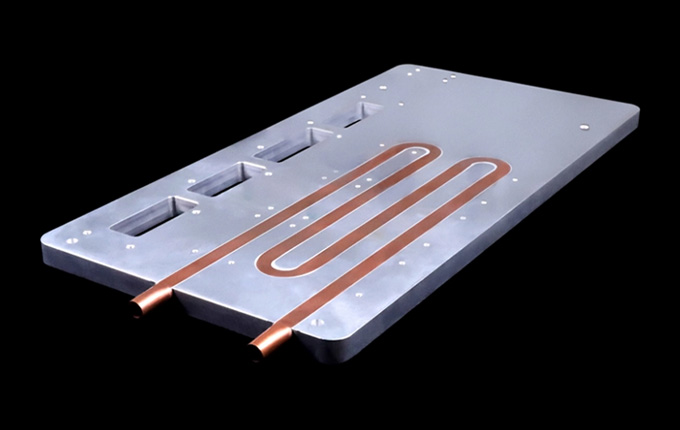
Tube Liquid Cold Plate (Embedded Tube): This is the simplest and most cost-effective flow channel design. We utilize precision CNC milling to cut grooves into an aluminum base plate, embed copper or stainless steel tubes, and secure them using highly conductive thermal epoxy or welding. It is highly reliable and excellent for basic fluid routing.
Deep Hole Machining (Gun Drilling): By drilling a series of intersecting cross-holes into a solid aluminum block and precisely plugging specific entry points, we create a continuous internal cooling circuit. Because no localized heating (like welding) is used to form the channels, this method introduces zero thermal stress into the metal, making it incredibly easy to achieve and maintain high surface flatness.
Friction Stir Welding (FSW): FSW utilizes advanced extrusion and a solid-state joining process (friction) to seal the cold plate. This technology provides exceptionally strong structural rigidity, a highly secure, leak-proof seal, and excellent surface flatness. It is widely favored for large-area cold plates, such as those used in EV battery packs.
Vacuum Brazing: This advanced process occurs in an oxygen-free vacuum furnace, allowing the seamless joining of dissimilar metals (such as aluminum, copper, and stainless steel). Vacuum brazing is the ultimate choice for manufacturing extremely complex, high-density, and highly efficient 3D flow channel assemblies where maximum heat transfer is required in a minimal footprint.
Manufacturing Process | Channel Complexity | Tooling Cost | Primary Engineering Advantage | Ideal Application Scenarios |
Embedded Tube | Low | Low | Cost-effective, simple design, fast to prototype. | General industrial electronics, low-wattage lasers. |
Deep Hole Machining | Low to Medium | Low-Medium | Zero thermal stress, excellent base flatness. | Mold cooling, heavy industrial tooling. |
Friction Stir Welding | Medium | Medium-High | High structural rigidity, excellent sealing for large areas. | EV battery plates, energy storage systems. |
Vacuum Brazing | Very High | High | Supports intricate micro-channels for maximum efficiency. | High-density data centers, aerospace, advanced medical. |
The demand for liquid cooling is largely driven by two rapidly expanding sectors: electric mobility and cloud computing. The thermal parameters for these industries are vastly different, yet both require absolute zero-failure rates.
Cloud Computing & Servers:
As AI and machine learning workloads escalate, data centers are shifting to Direct Liquid Cooling (DLC). We engineer cold plate systems specifically for high-density servers, targeting high-wattage CPUs and GPUs. By implementing optimized Thermal Management for EV and Data Centers, operators can drastically improve computing density per rack while reducing network latency caused by thermal throttling.
Electric Mobility (eMobility):
The automotive sector requires cooling systems that are not only thermally efficient but also incredibly robust against vibration and mechanical shock. Our engineering team develops lightweight, high-strength liquid cooling systems for electric vehicle (EV) battery pack cold plates, power conversion devices, inverters, and low-power onboard telematics systems. FSW (Friction Stir Welding) is heavily utilized here to ensure large-format plates remain structurally sound and completely leak-free over years of road vibration.
Beyond automotive and IT, liquid cooling is the backbone of critical industrial and life-saving medical infrastructure.
Industrial Power Electronics: High-power-density equipment cannot afford downtime. We design targeted cooling solutions for industrial environments, including IGBT liquid cold plates (400W to 900W+), semiconductor test equipment cooling, and large-scale energy storage battery thermal management.
Medical Equipment: Medical imaging and laser systems require precise, highly stable temperature control to function accurately. We provide high-reliability cooling architectures for CT scanners, MRI machines, UV and laser cooling systems, and specialized ultrasound thermal equipment. In these applications, vacuum-brazed cold plates are frequently employed to manage complex flow paths within tightly constrained machine housings.
A cold plate is only as good as its seal and its surface interface. Even the most efficient internal channel will fail if the coolant leaks or if the mounting surface is uneven and prone to corrosion.
At Kingka, we enforce a Full-Process Quality Control regimen. We are an ISO 9001 certified manufacturer, and absolutely every liquid cooling component undergoes a 100% leak and pressure test before it leaves our facility. This ensures total reliability even under complex, high-pressure working conditions.
Furthermore, we support a wide array of precision surface treatments to protect the cold plate from environmental degradation and galvanic corrosion, including:
Standard and Color Anodizing
Hard Anodizing (for extreme wear resistance)
Sandblasting and Polishing (for optimal thermal interface mating)
Nickel Plating
Powder Coating and Electrophoretic Deposition (E-coating)
When engineering a high-power electronic system, supply chain agility is just as critical as thermodynamic performance. Partnering with a manufacturer who can rapidly transition a CAD model into a physical prototype keeps your R&D schedule on track.
Our Delivery Timelines:
Fast Prototyping: Custom sample lead times are typically executed in just 15 days.
Mass Production: High-volume production runs feature a reliable delivery cycle of 25-30 days.
Do not let thermal bottlenecks dictate your system's performance limits. Whether you need a simple embedded tube design for an industrial drive or a highly complex vacuum-brazed plate for an AI server rack, our engineering team is ready to assist.
Contact us today to review your CAD files, discuss flow channel optimization, and request a rapid prototype.
1. Why is liquid cooling better than air cooling?
Liquid coolants (like water or water-glycol mixtures) have a much higher specific heat capacity and thermal conductivity than air. Data shows liquid cooling is roughly 4 to 5 times more efficient at transferring heat, making it mandatory for power-dense components like 900W IGBTs or modern data center GPUs.
2. What is Friction Stir Welding (FSW) and why use it for cold plates?
FSW is a solid-state welding process that uses friction to join metals without melting them. It is ideal for cold plates because it creates an incredibly strong, leak-proof seal with excellent structural rigidity and base flatness, making it perfect for large EV battery cooling plates.
3. When should I choose Vacuum Brazing over an Embedded Tube design?
Choose Vacuum Brazing when you have severe space constraints but need maximum heat transfer. It allows for highly complex, 3D micro-channels that are impossible to machine with standard CNC. If budget is the primary concern and the heat load is moderate, Embedded Tube is the more cost-effective choice.
4. How do you test for leaks in liquid cold plates?
We enforce a strict 100% leak and pressure testing protocol on every unit before shipment. This typically involves pneumatic (air-under-water) or helium leak testing to ensure absolute integrity under the customer's specified operating pressure.
5. Can you manufacture cold plates for dissimilar metals?
Yes. Using our vacuum brazing process, we can successfully join dissimilar metals in an oxygen-free environment, such as integrating copper components with an aluminum or stainless steel base for targeted heat spreading.