English

Views: 6 Author: Site Editor Publish Time: 2026-05-09 Origin: Site
The transition from air to liquid cooling is no longer a futuristic concept; it is an immediate necessity for modern electronic engineering. Among the various thermal management solutions available, the deep machining liquid cold plate has established itself as an exceptionally reliable and mature engineering choice. Built from a single block of metal, these cold plates offer unparalleled structural integrity and leak resistance, making them a staple in mid-to-high heat flux applications.
However, the laws of thermodynamics dictate that every manufacturing process has a performance ceiling. As power densities in industrial electronics, telecommunications, and advanced computing continue to skyrocket, thermal engineers must confront a critical reality: standard gun-drilled channels eventually hit a thermal wall.
This comprehensive guide explores the engineering mechanics behind a deep machined cold plate, identifies its specific performance boundaries, and helps you determine exactly when your system requires an upgraded thermal architecture.
How Does a Deep Machined Cold Plate Function in Thermal Systems?
What Are the Signs You Need Custom Cold Plate Manufacturing?
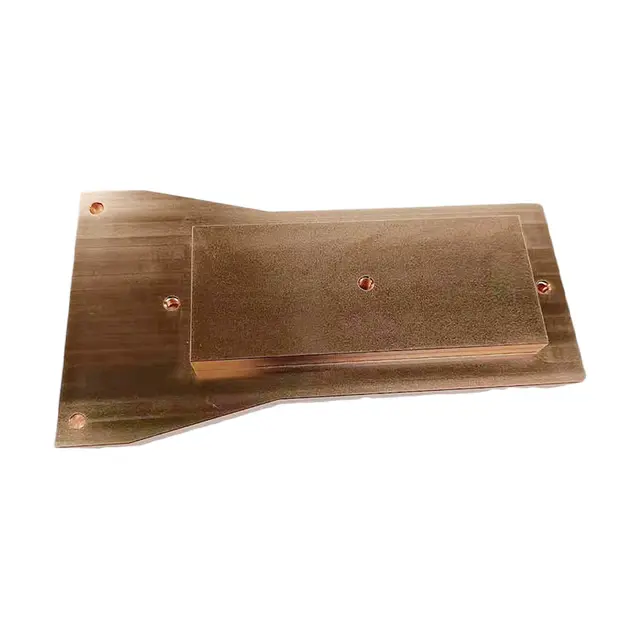
To understand the limits of a technology, we must first look at why it works so well. A CNC liquid cold plate created through deep machining (often referred to as gun drilling) relies on a subtractive manufacturing process. Instead of assembling multiple layers of metal and brazing them together, a CNC machine drills long, precise, parallel or intersecting channels directly into a solid aluminum or copper block.
The primary advantage of this one-piece monolithic construction is the complete elimination of welded or brazed interfaces. In traditional assembled cold plates, the joints are the most vulnerable points, susceptible to mechanical stress, thermal cycling degradation, and catastrophic coolant leaks. By keeping the metal body intact and only sealing the exterior drill entry points, a gun drilled cold plate offers extreme system stability and consistent flow paths.
Within the moderate power range, this method provides an incredibly stable liquid circulation system. It is the go-to solution for rugged environments where physical durability and zero-leak guarantees are just as important as heat dissipation.
While highly reliable, the physical characteristics of the deep machining process inherently limit its cooling capacity. The performance of these plates is dictated by the base material, the channel diameter, and the overall routing complexity.
Standard engineering benchmarks show that an aluminum liquid cooling plate provides a thermal conductivity of approximately 200 W/m·K. For more demanding systems, a copper-based version can push this to roughly 380–400 W/m·K. The internal flow channels typically range from 0.5 mm to 3 mm in diameter. With a well-optimized parallel or serpentine layout, this architecture is exceptionally proficient at managing mid-power electronics generating between 100W and 800W. With highly optimized systems, these liquid cooling modules can even scale up to manage heat loads approaching the 1kW mark.
However, as component footprints shrink and wattages spike, engineers must calculate the precise point where simple conduction and straight-line convection fail to keep pace. To better understand this specific thermal threshold, engineers spend significant time evaluating the exact heat flux limits of deep machining liquid cooling technology. When power density surpasses 100W/cm², the straight, un-finned walls of a gun-drilled channel simply cannot transfer heat into the fluid fast enough, leading to dangerous localized thermal stacking directly beneath the silicon die.
Table: Performance Benchmarks – Standard Deep Machined vs. Advanced Hybrid Cold Plates
Engineering Parameter | Standard Deep Machined Cold Plate | Advanced Hybrid / Microchannel Plate |
Optimal Power Range | 100W – 800W (Up to ~1kW) | 1kW – 3kW+ |
Max Heat Flux Capacity | < 100W/cm² | > 100W/cm² (Extreme density) |
Thermal Conductivity | ~200 W/m·K (Al) / ~400 W/m·K (Cu) | Mixed materials with localized high-K inserts |
Flow Path Flexibility | Restricted to straight intersecting lines | Complex 3D routing and targeted zones |
Pressure Drop | Low to Moderate | High (Requires higher pump power) |
Manufacturing Cost | Highly cost-effective at scale | Premium (Brazing/FSW required) |
When you push a deep machining liquid cold plate beyond its intended parameters, the symptoms of failure are predictable and mechanical. The limitations stem directly from how the channels are created: a drill bit can only move in a straight line.
Because the flow channels are restricted to linear, intersecting paths, the ability to create complex, 3D-optimized routing is inherently weaker compared to technologies like Friction Stir Welding (FSW) or vacuum-brazed microchannels. In standard operations, this is not an issue. But in ultra-high-density systems, this linear restriction means coolant cannot be micro-targeted directly into complex hotspot zones.
This limitation is particularly evident in the high-performance computing sector. As server architectures pack massive amounts of processing power into heavily constrained rack spaces, recognizing the exact point when a standard liquid cold plate transforms into a thermal bottleneck within AI server architectures becomes a critical part of system design. In these extreme environments, trying to compensate for linear channels by forcing higher coolant flow rates drastically increases the system's pressure drop. High pressure drop requires more aggressive pumping, which consumes excessive energy, creates unwanted vibration, and can lead to uneven fluid distribution across the plate.
To ground these thermal boundaries in reality, let us examine two common B2B engineering scenarios where standard deep machining begins to reach its limits.
Case 1: Industrial Power Module Dissipation
In industrial power conversion systems, deep machined plates are heavily relied upon to cool Insulated-Gate Bipolar Transistor (IGBT) modules. Initially, the results are phenomenal: temperature stability vastly outperforms traditional air cooling, module lifespans increase by roughly 30%, and the compact structure allows for sleeker equipment design.
The Limit: However, when manufacturers upgrade to next-generation, higher-power-density IGBTs, the single-channel structure struggles. Localized hotspots begin to form directly under the active chips. To mitigate this, engineers must shift away from standard deep machining and incorporate microchannel geometries or composite metal structures to bridge the cooling gap.
Case 2: EV Battery Auxiliary Cooling Systems
In the Electric Vehicle (EV) sector, an aluminum liquid cooling plate is the industry standard for auxiliary systems, including Battery Management Systems (BMS), power electronic modules, and auxiliary inverters. Deep machining is favored here because of its low cost, high manufacturing stability, and suitability for mass production.
The Limit: The paradigm shifts when the vehicle architecture is upgraded for ultra-fast DC charging or high C-rate discharging. In these scenarios, a simple straight-line drilled channel cannot uniformly distribute the sudden, massive influx of thermal energy. To prevent battery cell degradation, the system requires multi-loop configurations or FSW structures to achieve the necessary temperature uniformity.
Recognizing when your project has outgrown standard solutions is key to preventing late-stage redesigns and hardware failures. If your engineering team is experiencing any of the following pain points, it is time to pivot toward specialized custom cold plate manufacturing:
Persistent Localized Overheating: If your overall system temperature is acceptable but specific silicon dies are continuously throttling or failing, a gun-drilled plate cannot spread the heat fast enough. You need targeted flow dynamics.
Approaching the 500W+ Single-Module Threshold: If a single concentrated module in your layout is generating upwards of 500W, standard aluminum conduction will struggle to keep junction temperatures safe.
High Pressure Drop Warnings: If achieving the required cooling temperature requires a massive, loud, energy-heavy pump due to flow resistance in your dense drilled channels, your fluid dynamics are unoptimized.
Multi-Heat Source Constraints: When multiple high-power components are crammed into a tight physical space, linear drilled paths cannot adequately service every component without the fluid heating up too much before reaching the end of the loop.
These triggers indicate a clear demand for higher-performance, bespoke liquid cooling architectures, such as custom flow routing, hybrid material integration (like copper cores in aluminum plates), or multi-layered assemblies.
High-performance cooling is not merely a design challenge; it is fundamentally a manufacturing capability challenge. When standard deep machining reaches its thermal limits, transitioning to a more advanced solution requires a partner with deep OEM/ODM expertise.
Overcoming these bottlenecks requires:
Optimized Flow Routing Design: Moving beyond straight lines using advanced CNC milling combined with FSW to create serpentine, multi-zone, or micro-channel layouts that precisely target hotspots.
Material Upgrades: Transitioning from pure aluminum to localized copper inserts or composite structures to drastically increase the spreading of localized heat flux.
Stringent Quality Control: Advanced designs require rigorous testing. This includes precision CNC depth control, flawless flow consistency management, and extreme-pressure helium leak testing to guarantee batch stability.
If your system's power density is continuously rising and your current deep machining liquid cold plate is showing signs of strain, Kingka’s advanced engineering team is ready to help. By leveraging higher-order manufacturing processes—from hybrid micro-channels to precision FSW—we deliver the exact thermal management solutions required to keep your next-generation electronics running at peak performance.
Q1: What exactly is a gun drilled cold plate?
A gun drilled cold plate is a liquid cooling device manufactured by using a specialized, long drill bit (a gun drill) to bore straight, precise holes through a solid block of metal. These holes form the internal channels through which liquid coolant flows.
Q2: Why choose deep machining over brazed cold plates?
The primary advantage is structural integrity. Because the cold plate is made from a single solid piece of metal without any brazed or welded internal seams, the risk of coolant leakage is virtually eliminated. It is also highly cost-effective for moderate thermal loads.
Q3: What is the maximum wattage a deep machined cold plate can handle?
While it depends heavily on the surface area and coolant flow rate, standard deep machined aluminum plates excel between 100W and 800W. With highly optimized designs and copper materials, they can be scaled to manage loads around 1kW.
Q4: When does an aluminum liquid cooling plate become insufficient?
Aluminum becomes a bottleneck when the heat flux (wattage per square centimeter) becomes too extreme, typically above 100W/cm². At this point, aluminum cannot absorb and spread the heat fast enough, leading to localized hot spots, and materials like copper or vapor chambers must be considered.
Q5: How does deep machining affect pressure drop?
Simple, wide, straight gun-drilled channels have a very low pressure drop. However, if engineers try to cool higher wattages by drilling dozens of tiny, dense channels, the pressure drop increases significantly, requiring larger, more expensive pumps to push the fluid through.
Q6: What is Friction Stir Welding (FSW), and why is it an upgrade?
FSW is a solid-state joining process that creates seamless, incredibly strong bonds between metals. Unlike drilling, FSW allows engineers to CNC-mill complex, curved, 3D channel patterns into a base plate and then permanently seal a lid over it, offering vastly superior coolant targeting for high-density hotspots.
Q7: Does custom cold plate manufacturing take significantly longer?
While custom solutions require initial thermal modeling and CAD design, working with an experienced manufacturer with end-to-end CNC and testing capabilities ensures rapid prototyping. Once the prototype is validated, CNC mass production is highly efficient and scalable.