English

Views: 7 Author: Site Editor Publish Time: 2026-03-04 Origin: Site
Excessive heat is the primary killer of high-power electronics, causing severe degradation and system failure. Ignoring this drastically inflates warranty costs. The most critical thermal heat sink design balances material conductivity, optimized fin geometry for maximum surface area, and precise manufacturing tolerances to ensure long-term LED and power module reliability.
In the field, a theoretical cooling design often fails reality. I’ve seen industrial lighting arrays burn out within months because the heat sink couldn't handle continuous thermal cycling. Ensuring reliability isn't just about selecting a block of metal; it’s about engineering the precise thermal pathway.
Guessing the airflow dynamics of a power module is an expensive mistake. Simulating the thermal environment ensures the design can handle the actual heat flux before any metal is cut.
Thermal simulation precedes manufacturing because it accurately predicts heat distribution and airflow bottlenecks. By utilizing ANSYS FEM and 3D modeling, engineers can optimize the thermal heat sink design virtually, preventing costly prototyping errors and guaranteeing the reliability of high-power modules under continuous load.
At Kingka Tech, our approach over the last 15 years relies heavily on eliminating guesswork. We utilize advanced 3D modeling combined with ANSYS FEM (Finite Element Method) thermal simulation analysis. This allows our engineering team to visualize temperature gradients and identify exactly where spreading resistance is choking the system.
Multi-Angle Analysis:
Theoretical Basis: FEM breaks down the complex geometry of the heat sink into thousands of smaller elements, solving the heat equations computationally to predict the exact junction temperature ($T_j$) of the LED or IC.
Design Trade-offs: Simulation allows us to test whether a slight increase in fin pitch will reduce pressure drop enough to allow a quieter fan, or if we need to switch from aluminum to copper to hit our thermal targets.
Practical Impact: For instance, when designing for telecom processors or dense automotive power modules, ANSYS FEM ensures that the fin structure is perfectly tailored to the system's specific CFM (Cubic Feet per Minute) airflow, reducing development time by weeks.
Practical Advice: Never finalize a tooling order without first requesting a thermal simulation report from your manufacturing partner to verify that the theoretical $R_{th}$ (thermal resistance) meets your system requirements.
The foundation of any cooling solution is the raw metal. Selecting the wrong alloy creates a severe spreading resistance bottleneck that no amount of airflow can fix.
Material choices directly dictate conduction efficiency. High-purity Aluminum 1070 offers ~226 W/mK for cost-effective, rapid heat transfer, while pure copper reaches ~400 W/mK, completely eliminating spreading resistance in compact, high-flux environments required by modern power ICs.
Material selection is a balance of physics and economics. Engineers must match the thermal conductivity to the heat flux density of the specific application.
Specific Applications:
LED Street Lighting: High-purity Aluminum 1070 is often the ideal choice. Its thermal conductivity of ~226 W/mK is vastly superior to standard die-cast aluminum (ADC12, ~96 W/mK), making it excellent for large, passive cooling arrays where weight and cost are factors.
Server CPUs & IGBTs: When the heat source is small but generates massive wattage, Pure Copper is mandatory. Reaching ~400 W/mK, it rapidly pulls heat away from the die to prevent localized throttling.
Table 1: Material Performance and Application Comparison
Outdoor lighting faces brutal environmental conditions and requires robust convection. Traditional extrusions often lack the fin density or structural integrity needed for these harsh environments.
Cold forged designs are ideal for outdoor LEDs because the high-pressure forging process creates dense, pin-fin structures with exceptional thermal conductivity. This maximizes omnidirectional airflow, ensuring crucial junction temperatures remain within safe ranges during continuous industrial operation.
For a major industrial lighting client, Kingka Tech developed an E-Coated Aluminum 1070 Cold Forged Heat Sink specifically designed for high-power LED lighting.
Multi-Angle Analysis:
Manufacturing Mechanics: Cold forging forces high-purity aluminum into a die at room temperature. This avoids the porosity issues of die-casting, ensuring the final piece retains the full ~226 W/mK thermal conductivity of the raw 1070 alloy.
Geometric Advantage: Forging allows for the creation of intricate "pin-fin" arrays. Unlike extruded linear fins, pin fins allow air to flow from any direction, which is critical for passively cooled outdoor stadium lights or high-bay warehouse LEDs where airflow direction is unpredictable.
Environmental Durability: Outdoor environments cause rapid galvanic corrosion. We applied an advanced E-coating (Electrophoretic deposition) to the forged aluminum. This provided a durable, weather-resistant shell without significantly insulating the fins and compromising the convection cooling.
Practical Advice: For passively cooled outdoor applications, prioritize cold-forged pin fins over extruded profiles to maximize omnidirectional natural convection.
When chassis space is strictly limited, standard geometries fail to provide enough cooling surface area. This is where subtractive manufacturing techniques become absolutely necessary for system survival.
You should utilize skived fin technology when cooling high-power electronics in heavily constrained spaces. Skiving slices ultra-thin fins directly from a solid base, eliminating interface resistance and dramatically increasing the surface area required to dissipate intensive thermal loads.
In compact, intensive thermal environments like telecom power electronics and specialized medical LED modules, extrusion dies physically break if you try to pack the fins too tightly.
Multi-Angle Analysis:
The Skiving Process: We utilize a specialized CNC cutting tool to shave fins (down to 0.1mm thick) from a solid block of pure copper and bend them upright.
Thermal Barrier Elimination: Because the fin and base remain a single, monolithic piece of copper, there is absolutely zero thermal interface resistance between them. Heat travels seamlessly from the base up into the fin.
Real-World Application: We engineered a Pure Copper Skived Fin Heat Sink for a high-density power module client. By combining the ~400 W/mK conductivity of copper with the massive surface area of the skived fins, we maximized heat dissipation within their strict 1U height limit. We then utilized precise CNC machining to finalize the mounting points and base flatness, contributing directly to extended device reliability.
A heat sink is only effective if it sits perfectly flush against the silicon die. Microscopic air gaps act as insulators, severely crippling the entire thermal management system.
CNC machining precision directly affects the thermal interface by ensuring absolute base flatness. Advanced CNC techniques deliver tolerances as tight as ±0.05 mm, minimizing air gaps and reducing thermal interface resistance, which is vital for the reliable operation of sensitive power modules.
The connection point between the power IC and the heat sink base is the most critical junction in the entire thermal pathway.
Multi-Angle Analysis:
Theoretical Basis: Air has a thermal conductivity of roughly 0.024 W/mK. If the base of your heat sink is warped by even a fraction of a millimeter, air gets trapped. You must use thicker layers of Thermal Interface Material (TIM) to fill the gap, which increases the overall thermal resistance ($R_{th}$).
Manufacturing Precision: Kingka Tech employs advanced CNC machining to face-mill the base of our heat sinks, delivering fin and base tolerances as tight as ±0.05 mm. This mirror-like flatness allows for the thinnest possible application of thermal paste.
Specific Applications: This level of precision is non-negotiable for bare-die cooling (like high-end CPUs) and densely packed IGBT power modules where uneven mounting pressure can literally crack the silicon.
Testing Method: We use optical flatness testing and profilometers on the manufacturing line to guarantee that the base contact area meets the exact specifications required by the thermal simulation.
When industrial LED arrays or power converters push past 300 watts, solid metal conduction alone is no longer sufficient to prevent catastrophic thermal throttling.
The best approach for extreme 350W heat loads is integrating two-phase cooling. Combining a custom zipper fin heat sink with embedded heat pipes rapidly transports massive heat away from the localized hotspot, significantly boosting overall dissipation and ensuring long-term system reliability.
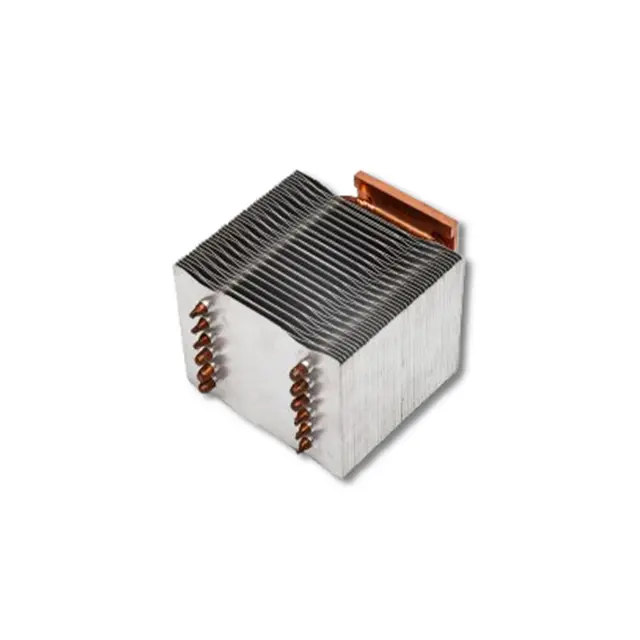
For a high-lumen industrial LED lighting project, solid copper was too heavy, and solid aluminum was too slow to move the heat.
Multi-Angle Analysis:
Phase-Change Physics: We engineered a Custom Zipper Fin Heat Sink integrated with 5 copper heat pipes. The internal fluid of the heat pipes vaporizes at the heat source, travels near the speed of sound to the cooler fins, condenses, and returns. This gives heat pipes an effective thermal conductivity exceeding 10,000 W/mK.
Zipper Fin Integration: To keep the unit lightweight, we soldered the heat pipes to a high-density "zipper fin" array—thin, stamped aluminum fins that interlock.
Performance Impact: This 350 W design efficiently transfers and dissipates large heat loads instantly. The heat pipes eliminate spreading resistance, while the zipper fins maximize the convective surface area, making it perfectly suitable for high-power LED lighting where thermal reliability directly dictates the lumen maintenance and lifespan of the diodes.
Theoretical simulations and precision manufacturing must be verified in the real world. A cooling module must prove it can survive the harsh realities of continuous thermal cycling.
In-house testing validates reliability by subjecting the thermal heat sink design to rigorous real-world conditions, including thermal shock and continuous load testing. This empirical validation guarantees that the manufactured cooling solution perfectly matches the theoretical performance required for high-power electronics.
With over 15 years of experience, Kingka Tech understands that delivering a reliable product requires closing the loop between the CAD file and the shipping dock.
Testing Protocols:
Thermal Performance Testing: We place the prototype into a wind tunnel and apply dummy heater blocks that mimic the exact wattage of your LED or power module. We measure the $\Delta T$ to ensure the $R_{th}$ matches the ANSYS FEM simulation.
Environmental Chamber Testing: For outdoor LED lighting components (like the E-coated cold forged designs), we utilize salt-spray chambers and thermal shock chambers to ensure the coating and structural integrity survive years of industrial abuse.
Practical Advice: Partner with a manufacturer that possesses in-house testing validation. Relying on third-party labs for initial prototype testing significantly delays your time-to-market.
1. What is the thermal conductivity of Aluminum 1070?
High-purity Aluminum 1070 offers a thermal conductivity of approximately ~226 W/mK, making it significantly more efficient than standard die-cast aluminum alloys (which typically sit under 100 W/mK) for rapid heat transfer.
2. Why is pure copper used in skived fin heat sinks?
Pure copper is used because of its exceptional thermal conductivity (~400 W/mK). When combined with the skiving process (which eliminates the base-to-fin thermal joint), it provides the absolute lowest spreading resistance for cooling dense, high-power ICs.
3. What is the benefit of E-coating on a cold forged heat sink?
E-coating (Electrophoretic deposition) provides a highly durable, corrosion-resistant finish. It protects aluminum heat sinks from harsh outdoor environments, moisture, and industrial chemicals without acting as a thick thermal insulator that would hinder LED cooling.
4. How does CNC machining improve heat sink performance?
Advanced CNC machining ensures absolute flatness at the base of the heat sink, with tolerances as tight as ±0.05 mm. This perfectly flat surface minimizes microscopic air gaps between the heat sink and the power module, allowing for thinner thermal paste application and drastically lower interface resistance.
5. When should heat pipes be added to a heat sink design?
Heat pipes should be integrated when the heat load is too extreme (e.g., 350W+) or too concentrated for solid metal to spread the heat quickly enough. They are essential for preventing thermal bottlenecks in high-power LEDs, CPUs, and industrial inverters.
6. What is ANSYS FEM, and why is it important for thermal design?
ANSYS FEM (Finite Element Method) is an advanced thermal simulation software. It allows engineers to virtually model heat distribution and airflow, optimizing the fin geometry and material choice before manufacturing begins, preventing costly errors.
7. What is the advantage of cold forging over extrusion?
Cold forging allows for the creation of complex "pin-fin" geometries that cannot be extruded. Pin fins allow air to flow through the heat sink omnidirectionally, making them vastly superior for passive, natural convection cooling in outdoor LED fixtures.
8. Why use a zipper fin array instead of a solid block?
Zipper fins are stamped from very thin metal sheets and interlocked, creating massive surface area while remaining incredibly lightweight. When soldered to heat pipes, they provide extreme cooling capacity without the heavy weight of a solid extruded or skived block.