English

Views: 14 Author: Site Editor Publish Time: 2026-04-08 Origin: Site
As we navigate the intense thermal demands of 2026, the electronics industry is obsessed with extreme cooling. With the rise of AI processors and high-density semiconductor packaging, many engineering teams instinctively default to microchannel cold plates. However, this reflex often leads to a massive, hidden problem: over-engineering.
When engineers specify expensive microchannel architectures for systems that do not generate extreme, concentrated heat flux, they unnecessarily inflate project budgets and introduce long-term reliability risks. The critical question for B2B procurement today is: Is the cost advantage of a simpler technology still valid?
The answer is a resounding yes. For a vast majority of mid-power applications, a Deep Machining Liquid Cold Plate offers the perfect equilibrium between robust thermal performance, supreme structural reliability, and aggressive cost control.
Here is a deep dive into the Microchannel vs Deep Machining debate and why a one-piece aluminum construction remains a highly strategic choice in 2026.
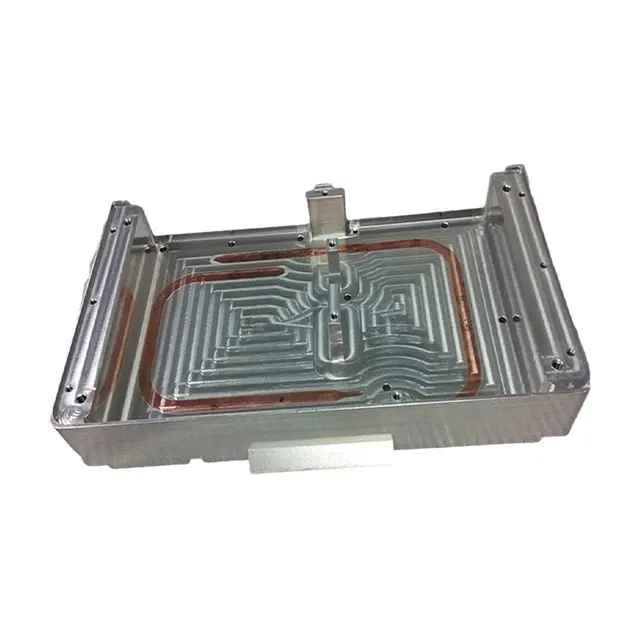
While microchannel cold plates are unparalleled at managing extreme heat flux, they come with significant manufacturing baggage. They require complex vacuum brazing or precise skiving processes. These methods are highly energy-intensive, slow to produce, and result in microscopic flow paths that are highly susceptible to clogging over time.
In contrast, deep machining (often referred to as gun-drilling) approaches cooling from a drastically simpler angle. Based on Kingka's optimized manufacturing processes, a deep-machined plate is created by drilling intersecting flow channels directly into a solid aluminum block and sealing the outer entry points.
This One-Piece Construction significantly simplifies the manufacturing flow. By avoiding the extreme premium associated with vacuum brazing, deep machining delivers unparalleled cost efficiency. In a highly competitive 2026 market—especially within the EV and telecom sectors—avoiding the "performance overcapacity" of a microchannel design is one of the easiest ways to protect your project's profit margins.
A cooling system is only as good as its weakest joint. Because microchannel and traditional assembled plates require multiple layers of metal to be welded, brazed, or glued together, they inherently possess multiple potential failure points.
Deep machining entirely removes welding points and thermal interfaces from the core cooling area. Because the heat transfers through a continuous, solid block of metal, there are no thermal boundary layers acting as microscopic insulators. For engineers, this pure metal-to-metal conduction means two things:
Zero Mechanical Stress: No welded seams to crack under vibration.
Leak-Proof Reliability: By eliminating internal joints, the risk of coolant leakage is drastically reduced, ensuring long-term operational safety for sensitive electronics.
You might assume that lowering the cost means severely sacrificing performance, but the data tells a different story. The heat dissipation of a deep-machined cold plate easily rivals the traditional "copper-tube-in-aluminum" approach.
More importantly, deep machining excels in fluid dynamics. Microchannels create massive flow resistance, requiring powerful, energy-hungry pumps to push coolant through the tiny fins. Deep-drilled channels, however, can be engineered to precisely guide the cooling liquid, offering smooth fluid dynamics that are highly effective at minimizing pressure loss and promoting excellent cooling uniformity across the plate.
Furthermore, because deep machining is a cold mechanical process, the base material does not undergo the severe thermal cycling required in vacuum brazing. As a result, deep-machined plates maintain significantly better surface flatness and tighter tolerances. In high-precision applications where the cold plate must sit perfectly flush against a large power module, this exceptional flatness is a critical data advantage.
When evaluating thermal architectures, it is crucial to look at the broader manufacturing landscape. [If you are comparing deep machining vs other liquid cooling technologies to understand what engineers need to know about tubed or brazed alternatives], the fundamental difference always comes down to manufacturing complexity and structural integrity. Unlike tubed designs that suffer from interface resistance, or brazed designs that risk internal warping, deep machining provides a perfectly flat, monolithic block that balances moderate cooling loads with zero-leak confidence.
In the push for cost-reduction across global industries in 2026, deep machining is dominating specific mid-power sectors:
EV & Battery Cooling: The electric vehicle market is hyper-focused on reducing production costs. Deep-machined cold plates are the ideal choice for low-power EV systems and battery pack thermal management. They perfectly balance budget and cooling demands, entirely avoiding the unjustified price premium of microchannel designs.
Telecommunication Equipment: 5G and early 6G base stations, as well as data exchange equipment, must operate flawlessly in compact, remote spaces. Because telecom operators are highly sensitive to both budget overruns and the catastrophic risks of liquid leaks, the structurally impenetrable nature of a deep-machined plate makes it the premier choice.
Power Conversion and Industrial Electronics: Heavy-duty inverters, motor drives, and high-power LED systems require thermal solutions that are as structurally rugged as they are economical. The solid aluminum block design provides high structural strength to support heavy industrial components without warping.
In 2026, overpaying for thermal management is an engineering flaw, not a feature. If your application does not involve the extreme heat flux of an AI accelerator, deploying a microchannel cold plate is an unnecessary drain on your budget.
A Deep Machining Liquid Cold Plate offers the ideal synergy of cost control, unbeatable leak resistance, and superior surface flatness. At Kingka, we leverage decades of CNC machining and thermal engineering expertise to optimize your drilled channel layouts, ensuring maximum heat extraction with minimal pressure drop.
Stop paying for performance you don't need. Contact the Kingka engineering team today to review your mid-power thermal requirements and request a rapid prototyping quote for a customized deep-machined cold plate.
Metric / Feature | Microchannel Cold Plate | Deep Machining (Solid Block) | Copper-Tube-in-Aluminum |
Primary Advantage | Extreme heat flux management | Cost efficiency & High reliability | Very low initial cost |
Structure | Multi-layer, vacuum brazed/skived | One-Piece Construction | Aluminum base + embedded tubes |
Leakage Risk | Moderate (Multiple brazed joints) | Extremely Low (Only external plugs) | Moderate (Tube seal degradation) |
Pressure Loss | Very High (Requires strong pumps) | Low (Smooth fluid dynamics) | Low |
Surface Flatness | Good (but risks warping from heat) | Excellent (No thermal cycling) | Good |
Ideal Application | AI processors, extreme density | EV batteries, Telecom, IGBTs | Low-cost standard electronics |
1. What is a Deep Machining Liquid Cold Plate?
It is a cooling plate manufactured by drilling deep, intersecting holes directly into a solid block of aluminum to create fluid flow channels, rather than assembling multiple pieces of metal together.
2. Why is Microchannel cooling so much more expensive?
Microchannel plates require cutting microscopic fins into copper or aluminum and then sealing the assembly in a highly controlled, energy-intensive vacuum brazing furnace. This process is slow, technically difficult, and costly.
3. Does Deep Machining have a high risk of clogging?
No. Because the drilled channels are generally larger and smoother than the microscopic pathways in a microchannel plate, deep-machined plates are highly resistant to clogging and scale buildup over time.
4. How does "One-Piece Construction" improve reliability?
Every time you weld, braze, or glue two pieces of metal together, you create a potential failure point. A one-piece solid block eliminates internal joints, meaning there are no internal seams to crack or leak under fluid pressure or vibration.
5. Are Deep Machined plates flat enough for bare-die mounting?
Yes. Because the aluminum block does not undergo the extreme heat of welding or brazing (thermal cycling), it does not warp. This allows for tighter CNC tolerances and exceptional surface flatness, ensuring excellent contact with the heat source.
6. Can Deep Machining handle the cooling needs of modern EVs?
Absolutely. For the vast majority of EV battery packs, onboard chargers, and low-to-mid power inverters, deep machining provides more than enough cooling capacity while keeping the vehicle's manufacturing costs down.
7. How do you seal the drilled holes?
The entry points created by the drill bits are sealed using heavy-duty, precision-engineered metal plugs. These plugs are often threaded or press-fitted with high-grade sealants to ensure absolute watertight integrity at the plate's exterior edges.