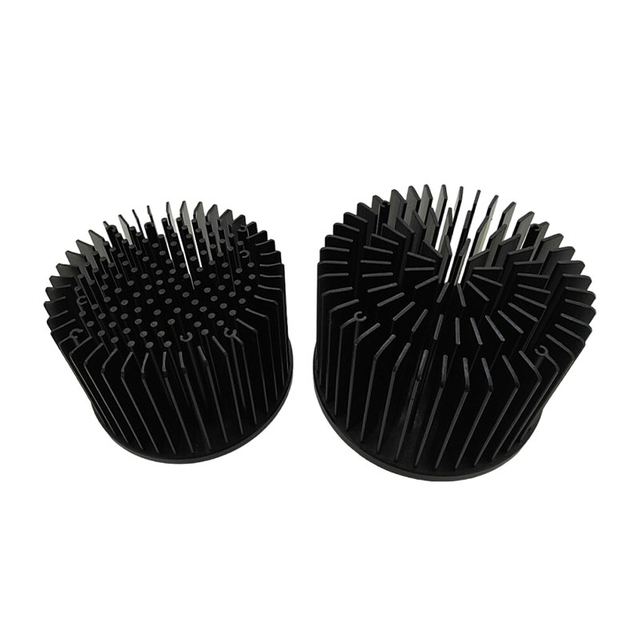
C1100 copper billet is forged at room temperature in a hardened die; the pin field forms in one stroke and work hardens as it flows. The base is then machined flat, the outline trimmed, and the part cleaned. Where the application needs it, the surface is nickel plated or left bare with a protective wrap for shipping. Whether copper is justified at all is the question in copper vs aluminum heatsink.
Copper conductivity at the fin root.
Hundreds of pins in one stroke.
Strength gained during forming.
Density replaces footprint.
For corrosion and solderability.
| Base Material | Copper C1100, cold forged pin field |
|---|---|
| Material | Copper C1100 |
| Pin Field | Square or diamond pitch, forged |
| Base | Machined flat after forging |
| Finish | Bare or nickel plated |
| Base CNC Tolerance | Milling / drilling / tapping down to +/-0.005 mm |
| Dimensional Inspection | Hexagon CMM +/-0.001 mm; 2.5D optical projector |
| Quality System | ISO 9001:2015; IATF 16949:2016 |
| Capacity | 60,000+ thermal parts per year |
| Lead Time | Samples typically 7-15 days; production scheduled to volume |
Note: values above are KingKa build options and verified capability; final geometry, holes and finish are confirmed against your drawing.
Copper work hardens faster than aluminum, so the forging sequence and any anneal between steps are set for the alloy, not copied from an aluminum program. Die life is quoted on that basis.
Design & CFD. 3D layout with CFD review sizes the fin field, pipe route and base thickness to the load and airflow.
Base machining. Plate, pockets and pipe channels are milled on 50+ CNC centers to +/-0.005 mm.
Fin and pipe joining. Fins skived, stacked or extruded; pipes pressed and soldered; the stack joined to the base by the process the design calls for.
Face fly-cutting. Contact face machined flat after joining so the part sits true on the device.
Final inspection. Hexagon CMM (+/-0.001 mm) and 2.5D projector check critical features; 4-stage IQC / IPQC / FQC.
Fin pitch and height - measured against the drawing before packing.
Base flatness - fly-cut face checked on the contact side.
CMM report - critical dimensions to +/-0.001 mm.
Joint inspection - solder or weld fillet checked along the stack feet.
Visual and batch audit - IQC / IPQC / FQC on every run.
Copper forged sinks are used where a small source has to be spread fast:
High-flux power devices
Laser diode mounts
RF power stages
Test and burn-in fixtures
Compact high-power modules
Send the device footprint, the load and the space allowed. KingKa checks whether the part should be copper or aluminum first, then sets the pin pattern and base thickness against the spread requirement. The small dense version of the same material is the copper pin fin heat sink.
KingKa is a direct manufacturer with 16+ years in thermal production, 50+ CNC centers, in-house skiving, FSW and vacuum brazing, certified to ISO 9001:2015 and IATF 16949:2016.
State whether the part must be copper - if the base can spread the load in aluminum, the copper version costs more in material and tool wear without a thermal return.
One supplier for the whole assembly. Base, fins, pipes and hardware under one quality system.
CFD before tooling. Design review catches a bad layout before metal is cut.
Prototype to volume. Samples in 7-15 days, production scheduled to forecast.