-
Q How do I get started with a custom Skived Fin Heat Sink project?
A Getting started with your custom Skived Fin Heat Sink project is straightforward. We encourage you to contact our sales or engineering team with your project specifications, detailed thermal requirements, and any existing design files or concepts you may have. Our experienced team will then provide expert consultation, offer design recommendations tailored to your needs, and furnish a detailed quotation to help bring your custom cooling solution from initial idea to a tangible, high-performing product.
-
Q In which industries do Skived Fin Heat Sinks excel?
A Skived fin heat sinks excel in industries that demand high-performance thermal management within confined spaces. They are an ideal solution for critical applications across various sectors, including New Energy Vehicles (NEV), where they manage the heat of power electronics; IT & Data Centers, for cooling high-density computing components; Industrial Automation & Control, ensuring the reliability of heavy-duty equipment; Telecommunications (5G/Telecom), for efficient cooling of dense networking infrastructure; High-Power LED Lighting, extending the lifespan and performance of luminaires; and Medical Imaging & Diagnostics, maintaining the stability and accuracy of sensitive electronic devices.
-
Q What kind of manufacturing capabilities do you have for Skived Fin Heat Sinks?
A Our state-of-the-art facility is equipped with advanced, precision skiving machinery. This enables us to offer highly flexible production capabilities, ranging from rapid prototyping for quick design validation (with no tooling costs) to high-volume, automated manufacturing for large-scale projects. We are committed to guaranteeing consistent precision and quality across all production scales, ensuring that your heat sinks meet the highest standards and are delivered efficiently to meet your project timelines.
-
Q Can you provide custom Skived Fin Heat Sink designs for specific applications?
A Absolutely. As a direct manufacturer, customization is our specialty. We have the capability and expertise to tailor every aspect of your skived fin heat sink, including fin thickness (ranging from 0.05mm to 3mm), fin spacing, overall dimensions, and complex geometries. Our goal is to perfectly match your unique thermal and mechanical requirements. Our engineering team works closely with you from the initial concept phase through to the final product delivery, ensuring a cooling solution that integrates seamlessly with your design.
-
Q What materials are available for your Skived Fin Heat Sinks?
A We primarily offer high-purity aluminum skived fin heat sinks and copper skived fin heat sinks. Aluminum is typically chosen for its lightweight properties and cost-effectiveness, making it suitable for a wide range of applications. Copper, on the other hand, is selected for its superior thermal conductivity, which makes it an ideal choice for managing higher power thermal loads where maximum heat dissipation is critical.
-
Q What are the primary advantages of choosing skived fin technology for thermal management?
A Skived fin technology offers several significant advantages for thermal management. Its superior thermal performance stems from the elimination of thermal resistance, creating an optimal heat transfer path. Skived fins also allow for a higher fin density within a given volume compared to extrusion, thus enhancing cooling capacity. Furthermore, choosing skived fins means there are no expensive extrusion tooling costs, which significantly reduces initial investment and accelerates your product prototyping cycle without tooling lead times. This technology also provides substantial design flexibility, accommodating various base thicknesses and fin geometries for highly customized applications.
-
Q What exactly is a Skived Fin Heat Sink, and how does it differ from traditional heat sinks?
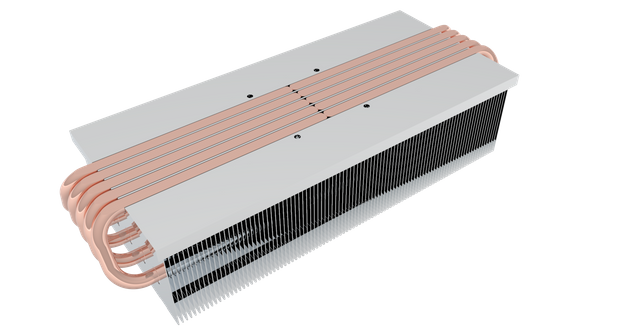
A A Skived Fin Heat Sink is manufactured by precisely shaving a single block of material, either aluminum or copper, to create thin, dense, upright fins. This integrated construction is a key differentiator as it completely eliminates thermal resistance typically found at the interface of bonded or brazed fins in traditional heat sinks. This results in a superior, more direct thermal path and significantly better heat transfer efficiency crucial for high-performance cooling applications.
 English