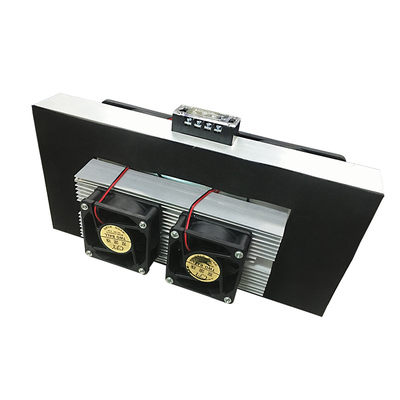


Bismuth telluride semiconductor pellets are arranged between two aluminium oxide ceramic plates, joined with solder, and sealed with leads brought out for the DC supply. The pellet pattern and the joint thickness are set so that differential expansion during cycling loads the elements as little as possible.
Built for repeated set-point changes.
Semiconductor pellets, not a refrigerant.
Thermally conductive, electrically isolating.
No sound, no vibration, no service parts.
Direction and magnitude set by current.
| Base Material | Bismuth telluride elements between alumina ceramic plates |
|---|---|
| Elements | Bismuth telluride semiconductor |
| Ceramic | Thermally conductive aluminium oxide |
| Operation | Solid state, no sound or vibration |
| Use | Cycling between several set points |
| Base CNC Tolerance | Milling / drilling / tapping down to +/-0.005 mm |
| Dimensional Inspection | Hexagon CMM +/-0.001 mm; 2.5D optical projector |
| Quality System | ISO 9001:2015; IATF 16949:2016 |
| Capacity | 60,000+ thermal parts per year |
| Lead Time | Samples typically 7-15 days; production scheduled to volume |
Note: values above are KingKa build options and verified capability; final geometry, holes and finish are confirmed against your drawing.
A TE module is rated by dT, not by wattage alone: the same module that moves 50 W at dT = 10 C moves far less at dT = 40 C, so the count follows the dT the application actually asks for.
Duty review. Hot-side temperature, dT and cycle profile define the module count.
Pellet assembly. Bismuth telluride pellets placed and soldered between ceramic plates.
Sealing and leads. Module sealed and leads brought out for the DC supply.
Cycling check. Sample modules cycled against the customer profile.
Final test. dT, resistance and insulation verified before packing.
dT at rated current - measured on a hot-side fixture.
AC resistance - checked per module.
Insulation - ceramic-to-element isolation tested.
Cycle endurance - verified against the agreed profile.
Visual and dimensional - flatness of both ceramic faces.
Cycling coolers are used where temperature has to move, not just hold:
Healthcare analysers
Laser diode packages
Sample storage chambers
Analytical instruments
Precision optics
Send the hot-side temperature, the required dT, the cycle profile and the footprint. KingKa sizes the module count to the dT, then sets the ceramic and joint for the cycle count you need.
KingKa is a direct manufacturer with 16+ years in thermal production, 50+ CNC centers, in-house skiving, FSW and vacuum brazing, certified to ISO 9001:2015 and IATF 16949:2016.
Give the cycle profile with the dT - cycling life is set by the profile, and the module has to be selected for that profile rather than for a catalogue wattage.
One supplier for the whole assembly. Base, fins, pipes and hardware under one quality system.
CFD before tooling. Design review catches a bad layout before metal is cut.
Prototype to volume. Samples in 7-15 days, production scheduled to forecast.